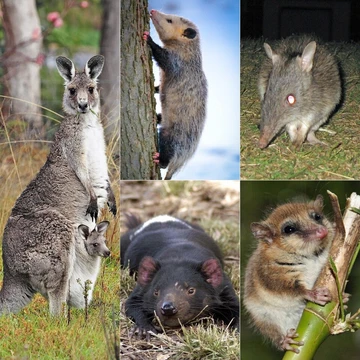
Western grey kangaroo
Large Australian kangaroo with a history of taxonomic confusion.
The western grey kangaroo (Macropus fuliginosus) is a large and very common kangaroo found across almost the entire southern part of Australia, from just south of Shark Bay through coastal Western Australia and South Australia, into western Victoria, and throughout the Murray–Darling basin in New South Wales and Queensland. It is one of the largest macropods in Australia, exhibiting sexual dimorphism with males reaching up to twice the size of females. The species has thick, coarse fur ranging from pale grey to brown, with paler colouring on the throat, chest, and belly. It is difficult to distinguish from its sibling species, the eastern grey kangaroo, but the western grey has darker grey-brown fur, darker colouration around the head, and sometimes a blackish patch near the elbow. The western grey kangaroo was long known to Aboriginal Australians. For Europeans, it was first noted when Matthew Flinders landed on Kangaroo Island in 1802, though he assumed the animals were eastern grey kangaroos. French explorers later captured several and shipped them to Paris, where researchers at the Paris Museum of Natural History formally described the species as Macropus fuliginosus in 1817. Taxonomic confusion persisted for almost 200 years, including an incorrect 1888 description placing the species in Tasmania. It was not until 1924 that researchers realized the Tasmanian "forester kangaroo" was actually the eastern grey, and by 1971 the Kangaroo Island population was understood to belong to the same species as kangaroos across southern and Western Australia. There are two subspecies: Macropus fuliginosus fuliginosus, endemic to Kangaroo Island, and Macropus fuliginosus melanops, which has forms that intergrade clinally from west to east. The species feeds at night on grasses, forbs, and leafy shrubs, and mature males have a distinctive curry-like odour, earning them the nickname "stinker." It is classified as Least Concern by the IUCN, with a population estimated at around 3,800,000 individuals within commercial harvest areas in 2020.
- Scientific name
- Macropus fuliginosus
- Weight
- 28–54 kg (62–120 lb)
- Length
- 0.84–1.1 m (2 ft 9 in – 3 ft 7 in) with a 0.80–1.0 m (2 ft 7 in – 3 ft 3 in) tail
- Height
- Approximately 1.3 m (4 ft 3 in)
- Conservation status
- Least Concern (IUCN)
- Gestation period
- 30–31 days
Lore & Background
The western grey kangaroo is one of the largest macropods in Australia, with males reaching up to twice the size of females. It has thick, coarse fur ranging from pale grey to brown, with a paler throat, chest, and belly. This species is difficult to distinguish from the eastern grey kangaroo, but it has darker grey-brown fur, darker colouration around the head, and sometimes a blackish patch near the elbow. It is found across almost the entire southern part of Australia, from just south of Shark Bay through coastal Western Australia and South Australia, into western Victoria, and throughout the Murray–Darling basin in New South Wales and Queensland. It is absent from the north and far southeast of Australia. The species is nocturnal, feeding mainly on grasses and forbs, and mature males have a distinctive curry-like odour, earning them the nickname "stinker." It lives in groups of up to 15, with males competing for females through "boxing" contests. The gestation period is 30–31 days, after which the joey attaches to the teat in the pouch for 130–150 days. Females reach sexual maturity at 17 months, males at around 20 months. The western grey kangaroo is closely related to the eastern grey, and their ranges overlap extensively, but they rarely interbreed in the wild.
Reader's Guide
The western grey kangaroo is significant as a widespread and abundant species across southern Australia, playing a key role in its ecosystems as a large herbivore. Its taxonomic history illustrates the challenges early European naturalists faced in distinguishing similar species, with confusion persisting for nearly two centuries. The species is notable for its unidirectional hybridization with the eastern grey kangaroo: viable offspring are produced only when a female eastern grey mates with a male western grey. Ecologically, it exhibits thermoregulatory adaptations, lowering its core body temperature in summer to conserve energy when food is scarce. Its diet during the Late Pleistocene was more varied and included more C4 plants than today. The species is commercially harvested for meat and leather, with about 40% of harvested meat used for human consumption. It is considered a pest in some agricultural areas due to competition for water and pasture, leading to licensed culling. The western grey kangaroo is classified as Least Concern by the IUCN, with an increasing population trend.
Did You Know?
- Mature males have a distinctive curry-like odour, giving the species the nickname 'stinker'.
- It never interbreeds with the eastern grey kangaroo in the wild, but hybrids can be produced in captivity from eastern grey females and western grey males.
- The Kangaroo Island subspecies (Macropus fuliginosus fuliginosus) is endemic to Kangaroo Island, South Australia.
Frequently Asked Questions
How big does a western grey kangaroo get?
Adults typically weigh between 28 and 54 kg (roughly 62 to 120 lb), with a body length of about 0.84 to 1.1 m plus a tail stretching another 0.80 to 1.0 m. At shoulder height they stand around 1.3 m (about 4 ft 3 in), making them one of the tallest kangaroos in the country.
Why was the western grey kangaroo so confusing to classify?
For nearly two centuries, European taxonomists kept mixing it up with its close relative, the eastern grey kangaroo, leading to a long stretch of misidentifications and reclassifications. The confusion only settled once researchers could clearly separate the two species by their distinct ranges and physical traits.
How is the western grey kangaroo related to the eastern grey kangaroo?
The two are very closely related macropods, which is exactly why they caused so much taxonomic headache for so long. The western grey tends to occupy the southern and western parts of Australia, while the eastern grey is more associated with the eastern states.
More in Marsupials 1-24
Spotted an error? Know more?
This is a living reference — every entry is fact-audited, and reader corrections feed straight into our audit queue. Suggest an edit · See this site's audit record