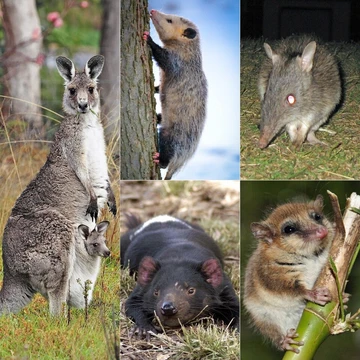
Quoll
Carnivorous marsupials native to Australia and New Guinea.

Quolls (genus Dasyurus) are carnivorous marsupials native to Australia and New Guinea. They are primarily nocturnal and spend most of the day in a den. Of the six species, four are found in Australia and two in New Guinea. Genetic evidence indicates quolls evolved around 15 million years ago in the Miocene, with ancestors of the six species diverging by around four million years ago. All species have declined since European colonization, with the eastern quoll becoming extinct on the Australian mainland in the 1960s.
- Scientific name
- Dasyurus
- Common name
- Quoll
- Native to
- Australia and New Guinea
- Number of species
- 6 (4 in Australia, 2 in New Guinea)
- Weight range
- 300 g to 7 kg
- Lifespan
- 1–5 years (species dependent)
- Conservation status
- Declining; one species extinct on Australian mainland
Lore & Background
Major threats include the toxic cane toad, feral cats and foxes, urban development, and poison baiting. Conservation efforts include captive-breeding programs and reintroductions. Fossil species have been found in Pliocene and Pleistocene deposits in Queensland, including D. dunmalli, but older quoll fossils from the Miocene also exist.
Reader's Guide
Quolls are significant as native carnivorous marsupials that have experienced drastic population declines since European colonization. Their decline highlights the impact of introduced species such as cane toads, feral cats, and foxes, as well as habitat loss and poison baiting. The eastern quoll's extinction on the Australian mainland in the 1960s underscores the vulnerability of these animals. Conservation efforts, including captive breeding and reintroductions, aim to restore populations. Quolls also have a rich taxonomic history, with their name derived from Aboriginal languages and their classification evolving over centuries. Their role as predators of small mammals, birds, reptiles, and insects makes them important in their ecosystems. The discovery of fossil species in Queensland provides insight into their evolutionary history, which began in the Miocene. Understanding quolls helps inform broader conservation strategies for Australian marsupials.
Did You Know?
- Quolls fluoresce under ultraviolet light.
- A female quoll can give birth to up to 30 pups, but only as many as her teats (which vary by species) can be raised.
- The spotted-tailed quoll is the largest species, with males weighing about 7 kg.
- The name 'quoll' comes from the Guugu Yimithirr word 'dhigul'.
Physical Form and Adaptations
The tiger quoll is the largest member of the quoll genus and the second-largest living carnivorous marsupial, behind only the Tasmanian devil. Adult males of the nominate subspecies average about 3.5 kilograms, with females around 1.8 kilograms, though exceptional males have reached nearly 8.9 kilograms. The animal's build is striking: short legs underpin a thick head and neck, a slightly rounded elongated snout, and a tail as long as the body and head combined. All four feet bear five toes, and the hind feet feature well-developed halluces. Long, pink, ridged foot pads provide grip for its moderately arboreal habits, compensating for a tail that is not prehensile. The pelage is usually reddish-brown with white spots, making it the only quoll to show spotting on its tail as well as its body; a minority carry black fur. Both fur and skin are coated in an orange-brown oil, while the underside stays greyish or creamy white. Most remarkably, the tiger quoll wields the second-most powerful bite relative to body size of any living mammalian carnivore, exerting a force of 153 newtons.
Hunting Strategy and Dietary Range
The tiger quoll is a highly versatile predator whose menu spans insects, crayfish, lizards, snakes, birds, domestic poultry, and a wide array of mammals including platypus, rabbits, cuscuses, greater gliders, bandicoots, pademelons, small wallabies, and even wombats. In one mainland study, feral rabbits alone constituted 76 percent of the diet. The quoll primarily hunts live prey, stalking its target and pausing only to raise its head before launching a sudden attack. For small prey, it pins the animal down with its forepaws and delivers a killing bite to the base of the skull or top of the neck. Against larger targets, it leaps onto the prey's back and clamps down on the neck. At night, it may climb into trees to pursue possums and birds, leaping between trunks as needed and descending head-first. The quoll will occasionally scavenge the carrion of kangaroos, feral pigs, cattle, and dingoes, though it does not rely on scavenging nearly as heavily as the Tasmanian devil. This dietary flexibility suggests that bushfires do not critically undermine its prey base.
Range, Habitat, and Conservation Status
Historically its range stretched from southeastern Queensland through eastern New South Wales and Victoria into southeastern South Australia and Tasmania. European settlement has severely fragmented the mainland population. In southeastern Queensland the species is now rare and largely confined to national parks; Victorian populations have dropped by nearly half. New South Wales has seen a less dramatic but still notable decline. In Tasmania it favours the northern and western regions with seasonal rains, though it has been extirpated from Flinders Island and King Island since the twentieth century. The species prefers humid forests, including rainforests and closed eucalypt woodland, and is listed as near-threatened on the IUCN Red List, with habitat loss from human activity as its primary threat. The northern subspecies, D. m. gracilis, is restricted to a small area of northern Queensland and is classified as endangered.
Daily Rhythms, Social Life, and Predation Pressure
Tiger quolls are generally nocturnal, spending daylight hours resting in dens that take the form of burrows, caves, rock crevices, tree hollows, hollow logs, or the spaces beneath houses and sheds. Juveniles and nursing females, however, may be spotted during the day. The animals travel by walking and bounding gaits, foraging and scent-marking along runways and roads. Most resident individuals in a given area are female. In the food web, the quoll faces predation from Tasmanian devils and masked owls in Tasmania, and from dingos, dogs, wedge-tailed eagles, and large pythons such as scrub pythons and carpet pythons on the mainland. A quoll will yield to an adult devil but will actively chase subadult devils away from carcasses. It also competes with introduced carnivores including foxes, cats, and feral dogs, and serves as a host to numerous species of endoparasites.
Frequently Asked Questions
What is a quoll?
A quoll is a small-to-medium carnivorous marsupial belonging to the genus Dasyurus, native to Australia and New Guinea. They are primarily nocturnal predators that spend daylight hours tucked away in a den.
How many species of quoll exist, and where are they found?
There are six recognized quoll species in total: four live in Australia and two are restricted to New Guinea. Their body mass spans roughly 300 grams up to about 7 kilograms depending on the species.
How old are quolls as a group?
Genetic evidence places the origin of the quoll lineage at roughly 15 million years ago during the Miocene epoch. The six modern species had already split from one another by about four million years ago.
What is the typical lifespan of a quoll?
Quolls generally live between one and five years, with the exact range varying from species to species. Their short lives are compounded by the fact that all six species have experienced population declines since European colonization began.
What happened to the eastern quoll on the Australian mainland?
The eastern quoll was driven to local extinction on the Australian mainland during the 1960s, a loss attributed to broader post-colonization pressures affecting quoll populations. It survives only in New Guinea populations today.
More in Marsupials 1-24
Elsewhere in the Marsupials universe
Spotted an error? Know more?
This is a living reference — every entry is fact-audited, and reader corrections feed straight into our audit queue. Suggest an edit · See this site's audit record