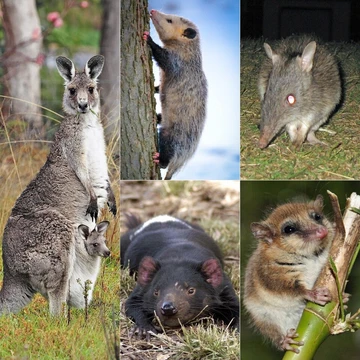
Diprotodontia
Largest marsupial order, including kangaroos, koalas, and wombats.

Extinct members include the hippopotamus-sized Diprotodon and Thylacoleo, the so-called 'marsupial lion.' The order is restricted to Australasia, with the earliest known fossils dating to the late Oligocene (approximately 28.4–23.03 million years ago), though gaps in the fossil record suggest the group began diverging well before that time.
- earliest_fossil_date
- Late Oligocene (approximately 28.4–23.03 million years ago)
Lore & Background
Living diprotodonts are almost all herbivores, as were most extinct species. A few insectivorous and omnivorous diprotodonts are known, and the Potoroidae are almost unique among vertebrates in being largely fungivorous, though these appear to be recent adaptations from the mainstream herbivorous lifestyle. The extinct thylacoleonids ('marsupial lions') are the only known group to have exhibited carnivory on a large scale.
Reader's Guide
Diprotodontia holds significant importance as the largest extant order of marsupials, encompassing iconic Australian fauna such as kangaroos, koalas, and wombats. Its members are defined by two key anatomical traits: diprotodonty (a pair of large, procumbent lower incisors) and syndactyly (fusion of the second and third foot digits). The order's fossil record extends to the late Oligocene, with extinct forms like the massive Diprotodon and the carnivorous Thylacoleo highlighting past diversity. The classification of Diprotodontia has been revised, with Kirsch et al. (1997) splitting families into three suborders: Macropodiformes, Phalangeriformes, and Vombatiformes. The order's evolutionary history includes complex transitions between arboreal and terrestrial lifestyles, as seen in tree-kangaroos. Understanding Diprotodontia provides insight into marsupial evolution, adaptation, and the ecological effects of human settlement in Australasia.
Did You Know?
- The extinct Diprotodon was hippopotamus-sized, and Thylacoleo is known as the 'marsupial lion.'
- Potoroidae are almost unique among vertebrates in being largely fungivorous.
- The earliest known diprotodont fossils date to the late Oligocene (approximately 28.4–23.03 million years ago).
Anatomy That Defines an Order
Diprotodontia gets its name from a straightforward anatomical trait: a pair of large, forward-projecting incisors on the lower jaw. The word itself derives from Ancient Greek roots meaning "two front teeth." This dental arrangement sits within a notably short jaw that typically bears three pairs of upper incisors, though wombats—much like rodents—carry only a single pair. Lower canines are entirely absent. The second signature feature, syndactyly, involves the fusion of the second and third toes or fingers up to the base of the claws, leaving the claws themselves free and separate. The fifth digit is usually missing altogether, while the fourth is frequently enlarged well beyond its neighbors. Researchers generally interpret syndactyly as a climbing adaptation, yet many modern diprotodonts are strictly ground-dwellers that have since reshaped their feet for terrestrial life. The tree-kangaroos tell a particularly tangled story: they were apparently arboreal in the deep past, descended to the ground and developed long, kangaroo-like hind legs, then climbed back into the canopy, where they evolved shortened, broadened feet and an entirely new climbing technique.
A Menu of Dietary Strategies
Nearly every living diprotodont is a herbivore, and the fossil record confirms that plant-eating was the dominant strategy across the order's history. A handful of insectivorous and omnivorous species are documented, but these represent relatively recent departures from the herbivorous mainstream rather than ancient lineages. The most striking dietary outlier is the Potoroidae family—bettongs, potoroos, and rat-kangaroos—which are largely fungivorous, a feeding strategy that is almost unique among all vertebrates. This fungal diet, too, appears to be a comparatively new adaptation layered onto the ancestral plant-eating pattern. At the opposite extreme, the extinct thylacoleonids, popularly called marsupial lions, stand as the only known diprotodont group that pursued carnivory on a large scale.
Deep Roots and Sudden Losses
The oldest confirmed diprotodont fossils come from the Late Oligocene, spanning roughly 23 to 28.4 million years ago. Yet scientists are confident the order's true origins lie considerably earlier, because Australia's fossil record contains enormous gaps and New Guinea—geologically active and thus poorly preserving bones—offers virtually no record at all. The sheer diversity of species already present in Oligocene deposits strongly implies that the major lineages had been splitting apart long before the first fossils were laid down. Many of the largest and least agile diprotodonts vanished around that time, alongside a broad swath of other Australian megafauna. While direct hunting cannot be ruled out, the more widely supported explanation points to sweeping habitat transformations driven by human activity, especially the widespread use of fire. Among the lost giants were the hippopotamus-sized Diprotodon and the fearsome Thylacoleo, the so-called marsupial lion.
A Taxonomy in Flux
For much of the twentieth century, taxonomists recognized only two suborders: Vombatiformes, housing the koala and wombats, and Phalangerida, which swept in every other family. That picture was overhauled by Kirsch and colleagues in 1997, who reorganized the families into three suborders. The Macropodiformes now include the musky rat-kangaroo, the kangaroo and wallaby family, the potoroid family, and the extinct Balbaridae. The Phalangeriformes are divided into two superfamilies: Petauroidea, covering feathertail gliders, sugar gliders, ring-tailed possums, and the honey possum, and Phalangeroidea, which holds pygmy possums, brushtail possums, cuscuses, and the extinct sprite possums. The Vombatiformes retain the koala and three wombat species alongside several extinct families, including the giant wombats and marsupial tapirs. A persistent debate continues over whether Macropodiformes nest as the sister group to Phalangeroidea or to Petauroidea within the broader Phalangeriformes.
Frequently Asked Questions
What are Diprotodontia's powers/role?
In practical terms, members of this order fill an enormous variety of ecological niches, from folivorous koalas in eucalyptus canopies to powerful grazing kangaroos on open plains. Their shared dental and jaw adaptations allow them to process tough vegetation, which is the key trait that unites the order.
How does Diprotodontia's story end?
The order is very much still alive and thriving today, so there is no single ending to its saga. However, several dramatic chapters have already closed: the hippopotamus-sized Diprotodon and the carnivorous Thylacoleo (the so-called 'marsupial lion') are both extinct, reminding fans that the cast list has shrunk over the millennia.
Why is Diprotodontia important?
As the biggest extant marsupial order, it accounts for the majority of species and biomass in Australia's and New Guinea's native mammal communities. Its members shape entire ecosystems through grazing, seed dispersal, and predation, and their evolutionary history offers a unique window into how marsupials diversified in isolation.
When was Diprotodontia first introduced?
The earliest confirmed fossils of the order date to the late Oligocene, roughly 28.4 to 23 million years ago. Gaps in the fossil record, however, strongly suggest that the lineage was already splitting into its major subgroups well before that window, pushing the true origin even further back in time.
More in Marsupials 1-24
Elsewhere in the Marsupials universe
Spotted an error? Know more?
This is a living reference — every entry is fact-audited, and reader corrections feed straight into our audit queue. Suggest an edit · See this site's audit record