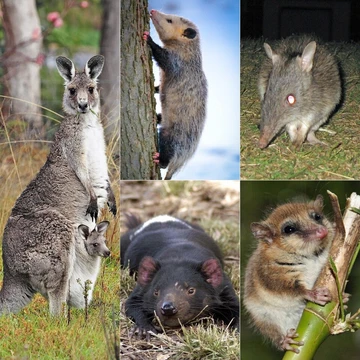
Opossum
Marsupials endemic to the Americas, often called living fossils.

Opossums are members of the marsupial order Didelphimorphia, endemic to the Americas. They are the largest order of marsupials in the Western Hemisphere, comprising around 90–100 species in about 18 genera. Originating in South America, they entered North America during the Great American Interchange following the connection of the continents in the late Cenozoic. The Virginia opossum is the only species found in the United States and Canada, often simply referred to as an opossum or possum. Opossums are typically nonaggressive and do not often transmit rabies.
- Scientific Order
- Didelphimorphia
- Number of Species
- around 90–100 species in about 18 genera
- Origin
- South America (Amazonia region)
- Oldest Fossils
- Late Paleocene or early Eocene (roughly 50 million years ago)
- Common Name in North America
- Opossum or possum
- Typical Lifespan
- One to two years in the wild; up to four or more years in captivity
Lore & Background
Opossums are often considered 'living fossils' and are used to approximate the ancestral therian condition in comparative studies. However, the oldest undisputed opossum fossils date from the late Paleocene or early Eocene, about 50 million years ago. The last common ancestor of all living opossums dates to the Oligocene–Miocene boundary, around 23 million years ago. Many extinct metatherians once thought to be early opossums are now recognized as belonging to older branches of Metatheria. Opossums probably originated in the Amazonia region of northern South America, where they began their initial diversification. They were minor components of South American mammal faunas until the late Miocene, when they began to diversify rapidly. Large opossums like Didelphis show a pattern of gradually increasing in size over geologic time as sparassodont diversity declined.
Reader's Guide
Opossums hold significance as the largest order of marsupials in the Western Hemisphere and as a key group for understanding marsupial evolution. Their status as 'living fossils' makes them valuable in comparative studies of the ancestral therian condition. The term 'possum' was later borrowed to describe distantly related Australian marsupials. Opossums exhibit unique biological traits, including a bifurcated reproductive system (the source of the name Didelphimorphia, meaning 'double-wombed'), sperm-pairing, and the involuntary 'playing possum' response. They are typically solitary, nocturnal, and semi-arboreal omnivores, with some species showing specialized diets such as frugivory or carnivory. The water opossum is the only living semi-aquatic marsupial. Opossums have an unusually short lifespan for their size, with rapid senescence, and females give birth to large litters of up to 20 young, though only a few survive to weaning.
Did You Know?
- Opossums have 50 teeth, an unusually full jaw by mammalian standards.
- When threatened, opossums involuntarily 'play possum,' mimicking a sick or dead animal for up to four hours.
- The water opossum (Chironectes minimus) is the only living semi-aquatic marsupial.
Origins and the Long Road North
Opossums trace their deepest roots to the Amazonia region of northern South America, where they first began diversifying. For a long stretch of their history, they remained minor players in South American mammal communities, with the ecological roles they fill today occupied by other metatherian groups such as paucituberculatans and sparassodonts. That balance shifted in the late Miocene, when opossums underwent a burst of rapid diversification. As sparassodont diversity waned, larger lineages like the genus Didelphis steadily grew in body size, and several groups even evolved carnivorous adaptations during the late Miocene-Pliocene, well before carnivorans reached South America. The Great American Interchange, triggered by the late Cenozoic connection of the two continents, opened the door for opossums to colonize North America. Though often called living fossils, the oldest known opossum fossils date to the early Miocene, roughly 20 million years ago, and their last common ancestor is estimated at about 23 million years old.
Physical Design and Ecological Range
Opossums are small to medium-sized marsupials that generally reach the size of a house cat. They share a suite of distinctive features: long snouts, narrow braincases, and a prominent sagittal crest along the skull. Their jaws carry an unusually full set of 50 teeth by mammalian standards, with very small incisors, large canines, and tricuspid molars. They adopt a plantigrade stance, placing their feet flat on the ground, and their hind feet include an opposable digit that lacks a claw. Some species grow prehensile tails, and both the tail and parts of the feet bear scutes. Males possess a forked penis with twin glandes, while many females retain a pouch. Ecologically, the order is remarkably diverse. Most members are opportunistic omnivores, yet the water opossum, or yapok, stands alone as the only living semi-aquatic marsupial, using webbed hindlimbs to dive for freshwater mollusks and crayfish. The lutrine and Patagonian opossums skew heavily toward predation, while Caluromyinae members are essentially frugivorous. Most are scansorial, suited to trees or ground, though groups like Glironiinae are primarily arboreal.
Reproduction and the Joey's First Journey
The reproductive biology of opossums reflects their marsupial heritage in striking ways. Females possess a bifurcated vagina and a divided uterus, and many species retain a pouch for carrying young. The Virginia opossum's estrous cycle runs about 28 days on average. While opossums do develop a placenta, it is short-lived, structurally simple, and far less functional than the placentas of placental mammals. Gestation is correspondingly brief, lasting only 12 to 14 days, after which litters of up to 20 young are born in an extraordinarily underdeveloped state. Once they emerge, each tiny joey must independently find its way to the marsupium, locate a teat, and latch on to nurse. This vulnerable early phase is a hallmark of marsupial life. The young are called joeys, a term shared with their Australian counterparts. Because female opossums often produce very large litters, the scramble for teats and the journey to the pouch becomes a critical survival challenge for every individual newborn.
Naming, Language, and the Possum Tangle
The word opossum carries a rich linguistic heritage rooted in the Powhatan language. Both men encountered the term at the English settlement of Jamestown, Virginia, where Smith helped found the colony and Strachey later served as its first secretary. Strachey described the animal as a beast in bigness of a pig and in taste alike, while Smith noted it had a head like a swine, a tail like a rat, and the bigness of a cat. The Powhatan word itself traces back to a Proto-Algonquian root meaning white dog or dog-like beast. The order's scientific name, Didelphimorphia, derives from Ancient Greek words meaning two, womb, and form. When Europeans arrived in Australia, the term possum was borrowed to describe the unrelated Phalangeriformes marsupials, creating a lasting naming overlap that persists to this day.
Frequently Asked Questions
What is an opossum?
Opossums are marsupials in the order Didelphimorphia, found only in the Americas. They make up the largest marsupial group in the Western Hemisphere, with roughly 90 to 100 species spread across about 18 genera.
Where did opossums originate and how did they reach North America?
Opossums first appeared in South America's Amazonia region, with fossils dating to the Late Paleocene or early Eocene around 50 million years ago. They crossed into North America only after the two continents joined during the Great American Interchange in the late Cenozoic.
How long do opossums live?
In the wild, most opossums survive just one to two years. In captivity, individuals can reach four years or occasionally a bit longer.
Are opossums dangerous or likely to carry rabies?
Opossums are generally nonaggressive and are considered among the least likely wild animals to transmit rabies. Despite their sometimes alarming reputation, they pose very little threat to humans.
Why are opossums called 'living fossils'?
Their lineage stretches back roughly 50 million years with a body plan that has changed very little since the Paleocene, making them one of the oldest continuously surviving marsupial groups. They are endemic to the Americas and represent a remarkably stable evolutionary line.
More in Marsupials 25-32
Elsewhere in the Marsupials universe
Spotted an error? Know more?
This is a living reference — every entry is fact-audited, and reader corrections feed straight into our audit queue. Suggest an edit · See this site's audit record