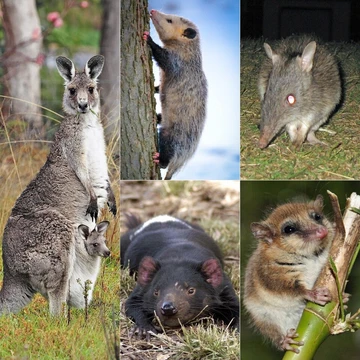
Common brushtail possum
Nocturnal marsupial, widespread in Australia and invasive in New Zealand.

The common brushtail possum (Trichosurus vulpecula) is a nocturnal, semiarboreal marsupial native to Australia and invasive in New Zealand. It is the second-largest of the Australasian possums and the Australian marsupial most often seen by city dwellers, thriving in a wide range of natural and human-modified environments.
- Scientific name
- Trichosurus vulpecula
- Head and body length
- 32–58 cm (13–23 in)
- Tail length
- 24–40 cm (9.4–16 in)
- Weight
- 1.2–4.5 kg (2.6–9.9 lb)
- Gestation period
- 16–18 days
- Lifespan in wild
- Up to 13 years
- Native to
- Australia
Lore & Background
The common brushtail possum has large, pointed ears and a bushy, prehensile tail with a hairless ventral patch. Its fore feet have sharp claws, and the first toe of each hind foot is clawless but strong. It grooms itself with fused third and fourth toes. Its thick, woolly pelage varies in color among silver-grey, brown, black, red, or cream, with lighter ventral areas and a brown or black tail. Males are generally larger than females and have reddish shoulders. Both sexes have a chest scent gland that secretes a reddish secretion used to mark territory.
Reader's Guide
The common brushtail possum is significant as one of the most widespread marsupials in Australia, found throughout eastern and northern parts, Tasmania, and several offshore islands, as well as in New Zealand after its introduction in the 1850s for the fur industry. In New Zealand, with few natural predators, it became a major agricultural and conservation pest. Its diet is largely folivorous, favoring eucalyptus leaves, but it also eats flowers, fruits, seeds, and small animals. It is inventive and determined around human habitations, raiding fruit trees and kitchens. The species faces threats in Australia from drought, disease, and invasive mammals, and its northern subspecies has declined substantially. In New Zealand, it is threatened only by humans and cats. Its ability to adapt to urban environments makes it a common sight for city dwellers.
Did You Know?
- The common brushtail possum's tail is prehensile and naked on its lower underside.
- It was introduced to New Zealand in the 1850s to establish a fur industry.
- Females have a gestation period of 16–18 days, giving birth to a single young that climbs into the pouch unaided.
- In New Zealand, brushtail possums are threatened only by humans and cats.
More in Marsupials 1-24
Elsewhere in the Marsupials universe
Spotted an error? Know more?
This is a living reference — every entry is fact-audited, and reader corrections feed straight into our audit queue. Suggest an edit · See this site's audit record