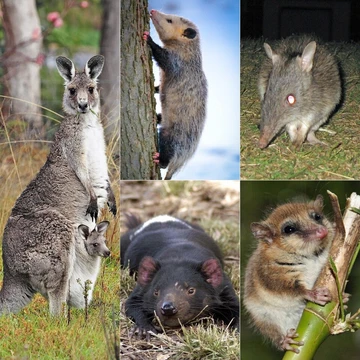
Wallaby
Small to mid-sized macropods native to Australia and New Guinea.

Wallabies are small or middle-sized macropods native to Australia and New Guinea, with introduced populations in New Zealand, Hawaii, the United Kingdom, and other countries. They belong to the same taxonomic family as kangaroos, but the term 'wallaby' is an informal designation for any macropod smaller than a kangaroo or wallaroo. Wallabies are hunted for meat and fur, and they face threats from predators such as dingoes, feral dogs, cats, and foxes, as well as human interactions including vehicular accidents.
- common_name
- Wallaby
- scientific_classification
- Family Macropodidae
- native_range
- Australia and New Guinea
- introduced_range
- New Zealand, Hawaii, United Kingdom, other countries
- diet
- Herbivore (grasses, vegetables, leaves, foliage)
- notable_genera
- Notamacropus, Petrogale, Lagorchestes, Onychogalea, Thylogale, Wallabia, Setonix, Dorcopsis, Dorcopsulus
- smallest_species
- Dwarf wallaby (Notamacropus dorcopsulus), length ~46 cm, weight ~1.6 kg
Lore & Background
Wallabies are not a distinct genetic group but fall into several broad categories. Brush wallabies (genus Notamacropus) are most closely related to kangaroos and wallaroos, and are the most frequently seen, particularly in southern Australia. Rock-wallabies (genus Petrogale) specialise in rugged terrain and have modified feet adapted to grip rock; at least 19 species exist, with several endangered. The banded hare-wallaby (Lagostrophus fasciatus) is thought to be the last remaining member of the subfamily Sthenurinae, restricted to two islands off Western Australia free of introduced predators.
Reader's Guide
Wallabies are significant as a diverse group of macropods that occupy a wide range of habitats across Australia and New Guinea, from rugged rocky areas to forests and semi-rural urban fringes. Their informal classification highlights the complexity of macropod taxonomy, with species ranging from the tiny dwarf wallaby to those nearly two metres long. Introduced populations in New Zealand, the United Kingdom, Hawaii, and elsewhere demonstrate their adaptability, though they are often considered pests in non-native environments. Conservation concerns exist for several species, including endangered rock-wallabies and the banded hare-wallaby, which is restricted to predator-free islands. Wallabies are hunted for meat and fur, and their interactions with humans—such as feeding near roads—lead to vehicular accidents. Their ecological role as herbivores and prey for dingoes, foxes, and feral cats underscores their importance in Australian and New Guinean ecosystems. The ongoing study of their physiology, such as tendon energy savings in the tammar wallaby, contributes to broader biological understanding.
Did You Know?
- The dwarf wallaby (Notamacropus dorcopsulus) is the smallest known wallaby species, measuring about 46 cm from nose to tail tip and weighing about 1.6 kg.
- A group of wallabies is called a mob, court, or troupe.
- The tammar wallaby has elastic storage in its ankle extensor tendons that reduces its metabolic rate by 30–50%.
- The banded hare-wallaby (Lagostrophus fasciatus) is thought to be the last remaining member of the subfamily Sthenurinae.
Frequently Asked Questions
What exactly is a wallaby?
A wallaby is a small to medium-sized hopping mammal that belongs to the macropod family. The name isn't a formal taxonomic category—it's simply the informal label people use for any macropod that's smaller than a kangaroo or wallaroo.
Where can I find wallabies in the wild?
They're naturally found across Australia and New Guinea, but human-introduced populations now also live in New Zealand, Hawaii, the United Kingdom, and a handful of other regions.
What's on a wallaby's menu?
Wallabies are strict herbivores, grazing on grasses, leafy vegetation, and various plant foliage throughout the day.
What are the biggest dangers to wallaby populations?
They're preyed upon by dingoes, feral dogs, cats, and foxes, and they also suffer from human-caused hazards like road collisions. Additionally, they are hunted commercially for both meat and pelts.
How do wallabies differ from kangaroos scientifically?
Both fall under the family Macropodidae, so they're close relatives, but 'wallaby' is purely a size-based, colloquial distinction rather than a separate scientific grouping. Genera like Notamacropus, Petrogale, and Thylogale represent the diversity within what we call wallabies.
More in Marsupials 1-24
Elsewhere in the Marsupials universe
Spotted an error? Know more?
This is a living reference — every entry is fact-audited, and reader corrections feed straight into our audit queue. Suggest an edit · See this site's audit record