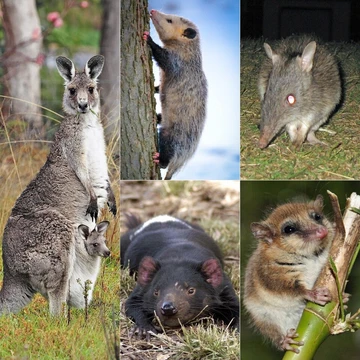
Dasyuromorphia
Order of mostly Australian carnivorous marsupials.

Dasyuromorphia is an order comprising most of the Australian carnivorous marsupials. The order contains three universally recognized families: Myrmecobiidae, with just a single living species, the numbat; Thylacinidae, with one recently extinct species, the thylacine, and several fossil species; and Dasyuridae, with 73 extant species, including quolls, dunnarts, and the Tasmanian devil. A fourth fossil family, Malleodectidae, has been proposed but is not yet universally accepted in mainstream marsupial taxonomy.
- body_size_range
- 4 grams (long-tailed planigale) to 35 kilograms (thylacine)
- smallest_marsupial
- long-tailed planigale (4 g)
Lore & Background
The body size of dasyuromorphs varies considerably, from only 4 grams in the long-tailed planigale (generally recognized as the smallest living marsupial), up to 35 kilograms in the recently extinct thylacine. They show considerable morphological diversity, including the kultarr, which is adapted for hopping locomotion. Members of the group are mostly carnivorous, either feeding on vertebrate prey or arthropods such as insects.
Reader's Guide
Dasyuromorphia represents the primary radiation of carnivorous marsupials in Australia, encompassing a wide range of body sizes and ecological roles. The order includes the recently extinct thylacine, a large apex predator, and the tiny long-tailed planigale, the smallest living marsupial. Their lower molar teeth typically show a carnassial-like morphology, and members are monophyodont, meaning they have only one set of teeth throughout life. Each erupting molar must function as a carnassial before being pushed forward by the next molar, a constraint that may have restricted their diversity relative to placental carnivorans. The order's four families include the living numbat, 73 species of dasyurids (quolls, dunnarts, Tasmanian devil), and the extinct thylacine and Malleodectidae. Their significance lies in representing Australia's native carnivorous marsupial lineage, with adaptations ranging from hopping locomotion to insectivory.
Did You Know?
- The long-tailed planigale is generally recognized as the smallest living marsupial, weighing around 4 grams.
- The thylacine, a recently extinct species, reached up to 35 kilograms.
- Most dasyuromorphs are diphyodont, having two sets of teeth (milk and adult) during their lives.
- The kultarr is adapted for hopping locomotion.
Taxonomic Composition and Family Diversity
Dasyuromorphia, pronounced da-see-yoor-oh-MOR-fee-ə, is an order that encompasses the majority of Australia's carnivorous marsupials. It is organized into four distinct families, each with a very different present-day representation. Myrmecobiidae is the most reduced, containing just a single living species: the numbat, Myrmecobius fasciatus. Thylacinidae is represented today only by fossils, its sole well-known member being the thylacine, Thylacinus cynocephalus, which has recently gone extinct, along with several other fossil species. Dasyuridae is by far the most species-rich family, holding 73 extant species that include quolls, dunnarts, and the Tasmanian devil. The fourth family, Malleodectidae, is known solely from the fossil record and is represented by a single genus. Together, these four families paint a picture of an order that spans the full spectrum from a single surviving species to a thriving radiation of over seventy.
A Spectrum of Body Sizes and Forms
One of the most striking features of Dasyuromorphia is the extraordinary range of body sizes it encompasses. At the lower extreme sits the long-tailed planigale, weighing a mere 4 grams, which makes it the smallest living marsupial on Earth. At the opposite end of the scale, the recently extinct thylacine reached approximately 35 kilograms, a size that places it among the larger carnivorous mammals of the Australian continent. Between these two poles, the order displays considerable morphological variety beyond just size. A particularly notable example is the kultarr, Antechinomys laniger, which has evolved a specialized hopping form of locomotion, setting it apart from the more generalized body plans seen in its relatives. This breadth of size and shape within a single order underscores the adaptive flexibility that the carnivorous marsupial lifestyle has afforded across a wide range of ecological niches.
Carnivorous Ecology and Dental Architecture
Members of Dasyuromorphia are predominantly carnivorous, drawing their nutrition from vertebrate prey or arthropods such as insects. This dietary strategy is clearly reflected in their dentition: the lower molar teeth typically exhibit a carnassial-like morphology, a shearing arrangement well suited to processing flesh and tough arthropod exoskeletons. However, the dental system of dasyuromorphs operates under a unique and restrictive condition. These animals are monophyodont, meaning they possess only a single set of teeth for their entire lives. As new molars erupt, each one must first serve as a functional carnassial before the next molar pushes it forward in the jaw. This sequential, single-use arrangement means that no individual molar can be repurposed for grinding, crushing, or other specialized tasks. The result is a dental architecture that is efficient for a carnivorous diet but inherently limited in the range of functions any one tooth can perform over its lifetime.
The Monophyodont Constraint and Its Evolutionary Consequences
The monophyodont condition of dasyuromorphs carries evolutionary implications that extend well beyond simple tooth replacement. Because each erupting molar must initially function as a carnassial before being displaced forward by its successor, the order is effectively locked into a single dental role for every molar that ever appears. Unlike placental carnivorans, which can evolve specialized grinding molars, elongated canines, or other modified teeth for diverse ecological roles, dasyuromorphs cannot dedicate particular molars to alternative functions. This restriction on dental versatility may have constrained the overall morphological and ecological diversity of the order relative to the carnivorans. In a group that already spans from a 4-gram planigale to a 35-kilogram thylacine, the inability to fine-tune individual teeth for specialized tasks represents a meaningful boundary on how far their adaptive radiation could proceed, potentially explaining why Dasyuromorphia has not diversified as broadly as its placental counterparts.
Frequently Asked Questions
Who is Dasyuromorphia?
Dasyuromorphia is the order that groups together most of Australia's carnivorous marsupials, spanning three widely accepted families—Myrmecobiidae, Thylacinidae, and Dasyuridae. It represents one of the most diverse lineages of meat-eating marsupials on the continent.
What are Dasyuromorphia's powers/role?
Members of this order fill the niche of small-to-medium carnivores across Australian and Tasmanian ecosystems, ranging from insect-hunting dunnarts to the larger quolls and the Tasmanian devil. Their predatory role helps regulate populations of small vertebrates and invertebrates.
How does Dasyuromorphia's story end?
The thylacine, once the order's most iconic large predator, disappeared from the wild by the mid-twentieth century, leaving Thylacinidae with no living representatives. The remainder of the order persists, though several dasyurid species continue to face pressure from habitat loss and introduced predators.
Why is Dasyuromorphia important?
With 73 extant dasyurid species plus the numbat, the order showcases an extraordinary radiation of carnivorous marsupials adapted to a wide range of Australian habitats. It also serves as a key case study for understanding how island isolation and competition with introduced species drive extinction.
What is the smallest member of Dasyuromorphia?
The long-tailed planigale holds that title at just 4 grams, making it one of the tiniest marsupials on Earth. At the opposite extreme, the now-extinct thylacine reached roughly 35 kilograms, giving the order a body-size range of nearly nine thousand-fold.
More in Marsupials 1-24
Elsewhere in the Marsupials universe
Spotted an error? Know more?
This is a living reference — every entry is fact-audited, and reader corrections feed straight into our audit queue. Suggest an edit · See this site's audit record