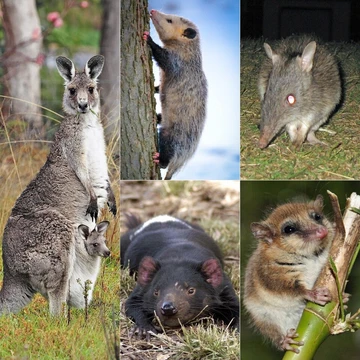
Peramelemorphia
Marsupial order of bandicoots and bilbies, endemic to Australia-New Guinea.

Peramelemorphia is an order of marsupials that includes bandicoots and bilbies. All members are endemic to Australia-New Guinea and typically have a plump, arch-backed body, a long tapering snout, large upright ears, long thin legs, and a thin tail.
- Common name
- Bandicoots and bilbies
- Scientific classification
- Order Peramelemorphia
- Distribution
- Australia-New Guinea
- Typical weight
- About 1 kg
- Distinctive features
- Polyprotodont dentition (three pairs of lower front teeth) and syndactyl hind foot (second and third toes fused)
Lore & Background
The phylogenetic position of Peramelemorphia within Marsupialia has long been puzzling. Members are polyprotodont (having several pairs of lower front teeth), suggesting a link to Dasyuromorphia (marsupial carnivores), yet they also have syndactyl feet (fused second and third toes), a trait characteristic of Diprotodontia (herbivorous marsupials like kangaroos and wombats). Three competing hypotheses attempt to resolve this: that bandicoots evolved from carnivores and independently developed syndactyly; that they evolved from a diprotodont ancestor and re-evolved extra teeth; or that they evolved from a primitive carnivore, developed syndactyly for climbing, and later gave rise to diprotodonts. Recent molecular studies suggest a distant relationship to other marsupial orders but have not resolved the puzzle.
Reader's Guide
Peramelemorphia is significant for its unique combination of traits that challenge simple evolutionary classification. The order's fossil record, though sparse, provides key insights into marsupial evolution in Australia. The earliest known fossil, Yarala burchfieldi from the Miocene, was primitive and led to the creation of a new superfamily and family. Later fossils such as Galadi speciosus, with a short snout suggesting carnivory, and Madju variae, which preserved an ontogenetic series, indicate that modern bandicoots' rapid development evolved after the middle Miocene as Australia became more arid. The oldest modern bandicoot and bilby fossils, from about 15 million years ago, include the peramelid Crash bandicoot and the bilby Liyamayi dayi. These discoveries highlight the order's deep history and its role in understanding marsupial diversification and adaptation to changing environments.
Did You Know?
- All members of Peramelemorphia are endemic to Australia-New Guinea.
- They have both polyprotodont dentition (three pairs of lower front teeth) and syndactyl hind feet (fused second and third toes).
- The oldest known peramelemorphian fossil is Bulungu muirheadae from the Eocene, meaning the group's fossil record extends back to the Eocene, not just the late Eocene or early Oligocene.
- No real fossil peramelid has been formally named 'Crash bandicoot'; that name is purely from the video game series.
Physical Form and Geographic Range
Every member of Peramelemorphia shares a recognizable silhouette: a rounded, arch-backed body paired with a long, finely tapering snout, oversized upright ears, slender legs, and a thin tail. This distinctive body plan unites bandicoots and bilbies alike, though the order spans a remarkable size spectrum. Geographically, the order is entirely confined to the Australia-New Guinea region—no peramelemorphian is found anywhere else on Earth. This strict endemic status makes the group a uniquely Australo-Papuan assemblage of marsupials, and their shared morphology strongly suggests a common ancestor that established this characteristic body shape before the lineage diversified across its limited geographic range.
The Phylogenetic Enigma
Where do bandicoots and bilbies fit among the other marsupials? This question has generated decades of debate because two prominent anatomical features point in contradictory directions. The order is polyprotodont—carrying three pairs of lower front teeth—which aligns it with Dasyuromorphia, the carnivorous marsupials. Yet their hind feet display syndactyly, a fusion of the second and third toes, a trait characteristic of Diprotodontia, the herbivorous group that includes kangaroos and wombats. Three competing hypotheses have emerged: one proposes descent from carnivores with an independent evolution of the fused toes; another argues that syndactyly is too unusual to arise twice, implying a diprotodont ancestor that re-evolved extra teeth; a third envisions a primitive carnivore that developed the fused foot as a climbing adaptation before diprotodonts branched off. Molecular studies to date have not settled the matter but do indicate that whatever the true relationship, it is a distant one.
A Fossil Record Written in Fragments
The deep past of peramelemorphians is reconstructed almost entirely from isolated teeth, partial jaws, and the occasional skull. The next addition came two decades later—a single upper molar from northern Queensland. Subsequent discoveries expanded the picture considerably: Yarala kida from the late Oligocene, the short-snouted and likely more carnivorous Galadi from Miocene deposits, and the mouse-sized Bulungu genus, whose oldest member dates to roughly 24 million years ago. Each find has pushed the known history of the order further back in time.
Untangling the Family Tree Within
Modern molecular analyses have provided a surprisingly well-supported picture of how peramelemorphians relate to one another. The deepest split separates the bilbies (Thylacomyidae, genus Macrotis) from every other member of the order, marking them as the most basal lineage. The next divergence likely belongs to the now-extinct Chaeropodidae (Chaeropus). All remaining taxa fall within Peramelidae, which divides into two major branches: the Peramelinae, encompassing Isoodon and Perameles, and a clade in which the Echymiperinae (Echymipera and Microperoryctes) form a sister group to the Peroryctinae (Peroryctes). This nested arrangement clarifies that the familiar bandicoots of Australia and New Guinea are not a single undifferentiated group but a structured assemblage with distinct evolutionary lineages, each tracing back to separate branching events within the order's history.
Frequently Asked Questions
Who is Peramelemorphia?
Peramelemorphia is the marsupial order that houses both bandicoots and bilbies, and every single member is native exclusively to the Australia–New Guinea region. Fans usually picture the classic silhouette: a plump, arch-backed body paired with a long tapering snout, big upright ears, and slender legs.
What are Peramelemorphia's signature traits?
The order is defined by two anatomical hallmarks—polyprotodont dentition (three pairs of lower incisors) and a syndactyl hind foot with the second and third toes fused together. Add the thin tail and long, thin legs, and you have the full Peramelemorphia look.
Why is Peramelemorphia important?
Being entirely endemic to Australia and New Guinea, this order has no close relatives anywhere else on the planet, making it a uniquely regional branch of the marsupial family tree. Ecologically, their constant foraging churns soil and helps keep insect populations in check across their native range.
What separates bandicoots from bilbies within the order?
Both sit under the Peramelemorphia banner, but bilbies are the smaller, more burrow-focused group, while bandicoots form the larger, more widely distributed family within the order.
More in Marsupials 25-32
Elsewhere in the Marsupials universe
Spotted an error? Know more?
This is a living reference — every entry is fact-audited, and reader corrections feed straight into our audit queue. Suggest an edit · See this site's audit record