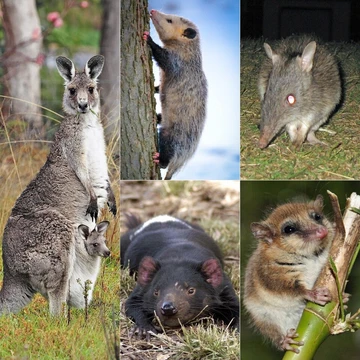
Phalangeriformes
Suborder of marsupials including possums, gliders, and cuscus.

Phalangeriformes are a suborder of Diprotodontia, comprising about 70 species of small to medium-sized marsupials native to Australia, New Guinea, and Sulawesi. They include possums, gliders, and cuscus, and are typically nocturnal and at least partially arboreal, inhabiting vegetated habitats with several species adapting well to urban settings.
- classification
- Suborder of Diprotodontia (monophyly debated)
Lore & Background
Phalangeriformes are quadrupedal marsupials with long tails, belonging to the order Diprotodontia, which also includes wombats, koalas, kangaroos, and wallabies. The suborder is split into two superfamilies: Phalangeroidea (including pygmy possums, brushtail possums, and cuscuses) and Petauroidea (including ring-tailed possums, gliders, and the honey possum).
Reader's Guide
Phalangeriformes are significant as a diverse group of Australasian marsupials that occupy a wide range of ecological niches, from arboreal herbivores to insectivores and nectar-feeders. Their ability to adapt to urban environments, as seen in the common brushtail possum, highlights their ecological flexibility. The group includes the smallest diprotodont marsupial, the Tasmanian pygmy possum, and the largest, the bear cuscus. The common name 'possum' derives from resemblance to American opossums, but the two groups are not closely related; Australasian possums are more closely related to kangaroos. The paraphyletic nature of Phalangeriformes, as noted in the source, underscores ongoing taxonomic debate. Their conservation and study contribute to understanding marsupial evolution and biodiversity in Australia, New Guinea, and Sulawesi.
Did You Know?
- The smallest phalangeriforme species is either the long-tailed pygmy possum or the feathertail glider, both of which can have a head-body length of around 65 mm and weight as low as 10 g; the Tasmanian pygmy possum is al
- The largest phalangeriforme species are the two species of bear cuscus, which may exceed 7 kg.
- The common name 'possum' for Australasian possums was borrowed from American opossums, not directly from the Powhatan word 'aposoum'.
- Australasian possums are more closely related to kangaroos than to American opossums.
Taxonomic Architecture and the Paraphyly Problem
Phalangeriformes represents one of the most species-rich groupings within the diprotodont marsupials, encompassing roughly seventy living species that span possums, gliders, and cuscuses across Australia, New Guinea, and Sulawesi. Taxonomically, the group is organized into two superfamilies—Phalangeroidea and Petauroidea—under which sit several families including the pygmy possums (Burramyidae), the brushtail possums and cuscuses (Phalangeridae), the ring-tailed possums (Pseudocheiridae), the gliders and striped possums (Petauridae), the solitary honey possum (Tarsipedidae), and the feathertail gliders (Acrobatidae). A fossil family, Ektopodontidae, adds a prehistoric dimension. However, the group's standing as a formal suborder is complicated: molecular analyses have repeatedly recovered Phalangeriformes as paraphyletic relative to Macropodiformes, meaning that if one insists on treating it as a natural clade, the kangaroos and wallabies would nest within it rather than alongside it. This unresolved phylogenetic tension makes Phalangeriformes a persistent challenge for mammalogists seeking clean, monophyletic categories.
Ecological Range and Dietary Specialization
Despite sharing a common suborder, phalangeriformes occupy an astonishing spread of ecological niches. Most species are nocturnal and at least partially arboreal, favoring vegetated environments, though several have adapted comfortably to urban landscapes. Their feeding strategies illustrate this breadth: the common brushtail possum is a generalist that will eat both plant matter and animal protein, while the greater glider has narrowed its diet to browsing almost exclusively on eucalyptus leaves. At the opposite end of the spectrum, the mountain pygmy possum is a dedicated insectivore, and the honey possum (Tarsipes rostratus) has evolved a highly specialized nectar-feeding lifestyle. These dietary differences coexist within a group whose members range from the tiny pygmy possums of the Burramyidae to the large cuscuses of the Phalangeridae. The geographic footprint is equally broad, stretching from mainland Australia through New Guinea to the island of Sulawesi, where the bear cuscuses and dwarf cuscuses occupy forested habitats. This mosaic of trophic roles and habitats makes Phalangeriformes one of the most ecologically diverse assemblages of marsupials on Earth.
A Spectrum of Body Sizes
Phalangeriformes are quadrupedal marsupials characterized by long tails, and within this body plan they span a remarkable range of sizes. At the lower extreme sits the Tasmanian pygmy possum (Cercartetus lepidus), which is not merely the smallest phalangeriforme but the smallest diprotodont marsupial known. An adult measures just seventy millimetres in head-and-body length and tips the scale at roughly ten grams. At the upper end, the two bear cuscus species (Ailurops melanotis and A. ursinus) can exceed seven kilograms, making them more than seven hundred times heavier than their pygmy counterparts. Between these poles, the group includes the common brushtail possum, the various ring-tailed possums, the sugar glider, the squirrel glider, and the feathertail glider, all of which fall into the small-to-medium category. This size gradient is not arbitrary; it tracks with dietary strategy and habitat use across the families. The long tail, a defining morphological feature of the group, accompanies their predominantly arboreal way of life.
The Possum Name and a Phylogenetic Surprise
The everyday word possum applied to these Australasian marsupials is a linguistic accident born of visual resemblance. Early European settlers in Australia saw these long-tailed, quadrupedal creatures and compared them to the opossums of the Americas, whose name traces back to the Powhatan word aposoum, meaning white animal, itself derived from a Proto-Algonquian root meaning white dog. The comparison stuck, and possum entered common usage across the region. Yet the evolutionary story tells a very different tale. Although both American opossums and Australasian possums are marsupials, they belong to entirely separate lineages. Phalangeriformes, as part of the suborder grouping within Diprotodontia, is far more closely allied to kangaroos, wallabies, and the musky rat-kangaroo (Macropodiformes) than to any New World metatherian. Indeed, roughly two-thirds of all Australian marsupial species fall under Diprotodontia, and the possums, gliders, and cuscuses form the largest and most diverse of its three suborders. The name, then, is a charming misnomer that obscures a deep Australasian kinship.
Frequently Asked Questions
What is Phalangeriformes?
Phalangeriformes is a suborder within Diprotodontia that groups together roughly 70 species of small-to-medium marsupials, most commonly recognized as possums, gliders, and cuscus.
Where are Phalangeriformes found?
These marsupials are native to Australia, New Guinea, and Sulawesi, where they occupy a range of vegetated habitats. Several species have also adapted surprisingly well to urban environments.
What are the key physical and behavioral traits of Phalangeriformes?
Members of this group are typically nocturnal and at least partially arboreal, spending much of their time in trees. Their small-to-medium body size and limb structure are well suited for climbing and, in gliders, for short aerial glides.
Is Phalangeriformes a universally accepted clade?
The monophyly of this suborder is actually debated among researchers, so its exact boundaries remain a point of discussion in marsupial systematics. It is nonetheless the most widely used informal grouping for these species.
Why do fans and researchers care about Phalangeriformes?
As a diverse and charismatic group that includes familiar species like the common brushtail possum and the sugar glider, Phalangeriformes serves as a key model for studying nocturnal ecology, urban adaptation, and marsupial evolution.
More in Marsupials 25-32
Elsewhere in the Marsupials universe
Spotted an error? Know more?
This is a living reference — every entry is fact-audited, and reader corrections feed straight into our audit queue. Suggest an edit · See this site's audit record