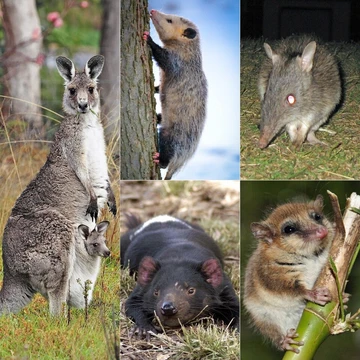
Marsupial
Mammals that nurture young in a pouch after brief gestation.

Marsupials are a diverse group of mammals belonging to the infraclass Marsupialia, natively found in Australasia, Wallacea, and the Americas. They are distinguished by their reproductive strategy: young are born in a relatively undeveloped state and nurtured within a pouch on the mother's abdomen. Extant species include kangaroos, koalas, opossums, possums, Tasmanian devils, wombats, wallabies, and bandicoots. Marsupials constitute a clade stemming from the last common ancestor of extant Metatheria, with the evolutionary split between placentals and marsupials occurring 125–160 million years ago in the Middle Jurassic–Early Cretaceous period.
- Infraclass
- Marsupialia
- Extant species
- 334
- Geographic distribution
- Australasia, Wallacea, and the Americas
- Key feature
- Abdominal pouch (marsupium) for nurturing young
- Largest living species
- Red kangaroo (up to 1.8 m, 90 kg)
- Smallest living species
- Marsupial mice (5 cm body length)
- Body temperature average
- 35 °C
Lore & Background
Reproductive systems differ markedly from placentals. Females have two uteri and two vaginas, with a median vagina forming a birth canal. Males typically have a split or double penis, and most marsupials possess a true cloaca, a single opening for the digestive and urogenital tracts. Marsupials give birth very early in gestation; newborns crawl to a teat, often inside a pouch (marsupium), where they remain for weeks. The pouch arrangement varies: kangaroos have a front-opening pouch, while many four-legged species have a rear-opening pouch. Some species, like the shrew opossum, develop a pouch only during gestation. The male water opossum has a pouch containing the penis and testes, though its function is debated and not specifically to keep the testes dry.
Reader's Guide
Marsupials represent a major branch of mammalian evolution, diverging from placentals over 125 million years ago. Their unique reproductive strategy—giving birth to underdeveloped young that complete development in a pouch—sets them apart and has allowed them to occupy diverse ecological niches across Australasia and the Americas. Approximately 70% of the 334 extant species are concentrated on the Australian continent, with the remainder in the Americas, including the Virginia opossum in North America. Marsupials exhibit convergent evolution with placentals, as seen in the thylacine resembling a wolf and sugar gliders paralleling flying squirrels. Their body temperatures average 35 °C, lower than similarly sized placentals. The fossil record includes giant forms like Diprotodon, weighing several tons. Understanding marsupials provides insight into mammalian adaptation, reproductive biology, and biogeography, highlighting how a single clade can radiate into forms as varied as kangaroos, koalas, and bandicoots.
Did You Know?
- The word marsupial comes from Latin marsupium and ancient Greek μάρσιππος (mársippos), meaning 'pouch'.
- Marsupials have a corpus callosum connecting the right and left brain hemispheres, though it is smaller and less developed than in placentals.
- The male water opossum has a pouch containing the penis and testes, though its function is debated and not specifically to keep the testes dry.
- The extinct Diprotodon reached several tons in weight, making it the largest known marsupial.
Evolutionary Origins and the Metatherian Lineage
Marsupials form a distinct clade rooted in the last common ancestor of all extant Metatheria, the group of mammals more closely allied with them than with placentals. The great divergence between these two major mammalian branches occurred somewhere between 125 and 160 million years ago, spanning the Middle Jurassic through the Early Cretaceous. That ancient split set marsupials on their own evolutionary trajectory, one that would eventually produce an extraordinary array of forms. Today the group encompasses 334 living species, ranging from the tiny long-tailed planigale at mere grams to the massive extinct Diprotodon that reached several tons. Roughly seventy percent of these species call the Australasian region home—mainland Australia, Tasmania, New Guinea, and surrounding islands—while the remaining thirty percent are scattered across the Americas, with thirteen species in Central America and the Virginia opossum as the sole representative north of Mexico. The very name traces back through Latin to the ancient Greek word for pouch, a fitting nod to the feature that most visibly distinguishes this lineage.
The Pouch and Reproductive Architecture
The hallmark of marsupial reproduction is the abdominal pouch, or marsupium, within which newborns—arriving in a remarkably undeveloped state—continue their development while nursing from multiple teats. Yet the reproductive anatomy extends far beyond the pouch itself. Female marsupials possess a doubled tract: two uteri and two vaginas, with a median vagina forming between them to serve as the birth canal. Most males carry a split or double penis positioned ahead of the scrotum, a structure not homologous to the placental equivalent. During embryonic development, all marsupials form a choriovitelline placenta, and bandicoots additionally develop a chorioallantoic placenta. The pouch itself varies widely in arrangement: front-opening in locomotive kangaroos, rear-opening in quadrupedal climbers, and in the shrew opossum it develops only during gestation as a temporary skin fold. Remarkably, the male water opossum also possesses a pouch, one that shields his genitalia during swimming and running.
Cranial and Skeletal Distinctions
Marsupial skulls are generally small and compact, yet they carry several features absent in placentals. A pair of frontal openings called foramina lacrimale sits at the front of the eye socket, cheekbones project further backward, and the lower jaw's angular process curves inward. The hard palate is perforated with more openings than its placental counterpart. Dentition is another clear differentiator: early marsupials carried a formula of 5.1.3.4/4.1.3.4 per quadrant, totaling fifty teeth, and many modern species retain between forty and fifty. In kangaroos and wallabies the formula drops to 3.0–1.2.4/1.000.2.4, and the second dental set erupts only from the third premolar backward, with all anterior teeth appearing as permanent structures from the start. Skeletally, most modern marsupials lack ossified kneecaps, and epipubic bones project forward from the pelvis in both sexes and in pouchless species alike, suggesting their original role was in hind-limb musculature rather than reproduction. Additionally, marsupials, like monotremes, lack a corpus callosum connecting the two brain hemispheres.
Convergent Evolution and Ecological Range
Marsupials have radiated into an astonishing variety of body plans, with the living red kangaroo standing up to 1.8 metres tall and weighing ninety kilograms, while marsupial mice measure a mere five centimetres in body length. This morphological breadth has produced striking cases of convergent evolution. The now-extinct thylacine grew so closely in form to a placental wolf that it earned the nickname Tasmanian wolf. Sugar gliders independently evolved the gliding membrane seen in flying squirrels, and kangaroos, though lacking a direct placental analogue, occupy ecological niches and lifestyles that echo those of ruminants. Even at the physiological level, marsupials run cooler than similarly sized placentals, averaging around 35 degrees Celsius compared to the placental 37, and some species bask in the sun to conserve metabolic energy. These parallels—spanning brain structure, locomotion, and thermoregulation—underscore how natural selection can sculpt remarkably similar solutions in lineages separated by over a hundred million years of independent evolution.
Frequently Asked Questions
What makes a marsupial different from other mammals?
Marsupials are defined by their unique reproductive method: after a very short gestation, the underdeveloped young crawls into an abdominal pouch called a marsupium, where it continues to grow and nurse until it's ready to leave. This pouch-based nurturing is the hallmark trait that sets the infraclass Marsupialia apart from placental mammals.
Where in the world can you find marsupials?
Marsupials are native to three main regions: Australasia (Australia, New Guinea, and nearby islands), Wallacea (the islands between Borneo and New Guinea), and the Americas, where opossums are the primary representatives. They are not naturally found in Africa, Europe, or mainland Asia.
What is the largest living marsupial?
The red kangaroo holds that title, reaching up to 1.8 meters in height and weighing as much as 90 kilograms. At the opposite extreme, marsupial mice are the smallest, with body lengths of only about 5 centimeters.
How many species of marsupials exist today?
There are 334 extant species across the infraclass Marsupialia, ranging from well-known animals like koalas and wombats to lesser-known groups such as bandicoots and possums. This clade traces back to the last common ancestor of all living Metatheria.
When did marsupials split from placental mammals?
The evolutionary divergence between the marsupial line and the placental mammal line is estimated to have occurred between 125 and 160 million years ago. This makes marsupials one of the oldest surviving branches of the mammalian family tree.
More in Marsupials 25-32
Elsewhere in the Marsupials universe
Spotted an error? Know more?
This is a living reference — every entry is fact-audited, and reader corrections feed straight into our audit queue. Suggest an edit · See this site's audit record