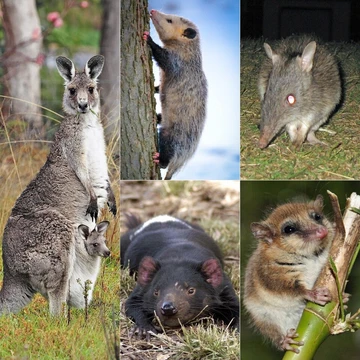
Virginia opossum
Northernmost marsupial, known for playing dead.

The Virginia opossum (Didelphis virginiana), also known as the North American opossum, is a marsupial found from southern Canada to northern Costa Rica, making it the northernmost marsupial in the world. It is a solitary nocturnal animal about the size of a domestic cat and a successful opportunist, frequently inhabiting settled areas near food sources like trash cans, pet food, and compost piles.
- Scientific name
- Didelphis virginiana
- Common name
- Virginia opossum (also called possum)
- Range
- Southern Canada to northern Costa Rica; expanding northward
- Size
- 33–55 cm body length, plus 25–54 cm tail; weight 1.9–2.8 kg
- Distinctive features
- 50 teeth, opposable thumbs on rear limbs, prehensile tail, 13 nipples
- Behavior
- Solitary, nocturnal, known for feigning death ('playing possum')
Lore & Background
The Virginia opossum's ancestors evolved in South America and spread into North America via the Great American Interchange after the Isthmus of Panama formed about 3 million years ago. Didelphis entered North America about 0.8 million years ago. Its pre-European settlement range extended as far north as Maryland, southern Ohio, Indiana, Illinois, Missouri, and Kansas. Clearing of dense forests and elimination of predators by settlers allowed the opossum to move northward. Some speculate that global warming causing warmer winters has aided this expansion, and that accidental transport across rivers by motor vehicles or trains may have contributed to its spread into Ontario.
Reader's Guide
The Virginia opossum is significant as the only marsupial native to North America north of Mexico, representing a successful example of range expansion following the Great American Interchange. Its ability to adapt to human-altered environments—feeding on trash, pet food, and carrion—has made it a familiar urban and suburban dweller. The opossum's distinctive behaviors, such as 'playing possum' (feigning death with a limp body, open mouth, and foul-smelling anal fluid), have entered popular culture as a metaphor for deception. Its tracks, with an opposable thumb on the hind foot, are unique among North American mammals. The species has one of the lowest encephalization quotients of any marsupial, with a brain one-fifth the size of a raccoon's. Despite its slow, nocturnal nature making it prone to roadkill, the opossum continues to expand its range northward and westward, including intentional introduction to the West Coast during the Great Depression.
Did You Know?
- The Virginia opossum has 50 teeth, more than any other North American land mammal.
- It has opposable, clawless thumbs on its rear limbs and a prehensile tail.
- When feigning death, its heart rate drops by half and breathing becomes barely detectable.
- The name 'opossum' comes from the Algonquian word wapathemwa, meaning 'white animal'.
Frequently Asked Questions
Who is the Virginia opossum?
The Virginia opossum (Didelphis virginiana) is a cat-sized, solitary, nocturnal marsupial that ranges from southern Canada all the way down to northern Costa Rica. It is the only marsupial species that lives north of the equator, making it the northernmost member of that entire group.
What are the Virginia opossum's signature abilities?
It sports a prehensile tail, opposable thumbs on its hind feet, and a full complement of 50 teeth, letting it grip branches, climb, and crunch through nearly any food item. Its most famous trick is collapsing into a rigid, lifeless pose—colloquially called 'playing possum'—to convince a predator that it is already dead.
What happens when a Virginia opossum feels threatened?
Rather than fight or flee, it typically drops into a death-like trance, goes limp, and may secrete a foul-smelling fluid to mimic decomposition. The performance can last anywhere from a few minutes to several hours before the animal 'wakes up' once the danger has passed.
Why is the Virginia opossum ecologically important?
As a prolific omnivorous opportunist it keeps populations of insects, small rodents, and even venomous snakes in check while also clearing out carrion and human waste in suburban areas. Its 13 nipples and high reproductive output make it a remarkably resilient species that thrives alongside expanding human settlements.
Where does the Virginia opossum live, and is its range changing?
It occupies a vast corridor from southern Canada through the United States and into northern Costa Rica, favoring wooded edges, farms, and suburban yards near easy food sources like trash cans and compost piles. Its range is currently creeping further northward as climates warm and urban habitats spread.
More in Marsupials 1-24
Elsewhere in the Marsupials universe
Spotted an error? Know more?
This is a living reference — every entry is fact-audited, and reader corrections feed straight into our audit queue. Suggest an edit · See this site's audit record