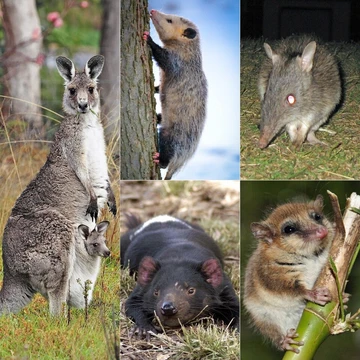
Kangaroo
Large marsupials native to Australia and New Guinea.

Kangaroos are marsupials from the subfamily Macropodinae, meaning 'large foot.' The term commonly refers to the largest species: the red kangaroo, antilopine kangaroo, eastern grey kangaroo, and western grey kangaroo. Indigenous to Australia and New Guinea, kangaroos are culturally significant as national symbols, appearing on the Australian coat of arms, currency, and logos such as Qantas and the Royal Australian Air Force.
- Scientific classification
- Family Macropodidae, subfamily Macropodinae
- Largest species
- Red kangaroo (Osphranter rufus)
- Maximum size
- 2 m (6 ft 7 in) tall, 90 kg (200 lb)
- Estimated population (2019)
- 42.8 million in commercial harvest areas of Australia
- Indigenous to
- Australia and New Guinea
- Distinguishing feature
- Large hind legs, long muscular tail, marsupial pouch
Lore & Background
The word 'kangaroo' derives from the Guugu Yimithirr word 'gangurru,' referring to eastern grey kangaroos.
Reader's Guide
Kangaroos are significant as symbols of Australia and as a key part of the continent's ecology and culture. They appear on the Australian coat of arms, currency, and as logos for Qantas and the Royal Australian Air Force. They are shot for meat, leather, and to protect grazing land; kangaroo meat is noted for low fat content. Large kangaroos have adapted better than smaller macropods to land clearing and habitat changes, while many smaller species are rare and endangered. Their specialized teeth, including polyphyodonty (shared only with elephants and manatees), allow them to graze on abrasive silica-rich grass. The term 'kangaroo' is part of a paraphyletic grouping that also includes wallaroos and wallabies, distinguished by size.
Did You Know?
- Kangaroos are paraphyletic; the term refers to the largest species in the family Macropodidae, while smaller ones are called wallabies and intermediate ones wallaroos.
- Kangaroo molars are polyphyodont: they move forward, fall out, and are replaced by new teeth growing in the back, a process otherwise seen only in elephants and manatees.
- Female kangaroos have a pouch called a marsupium where joeys complete postnatal development.
Frequently Asked Questions
What is a kangaroo?
Kangaroos are large marsupial mammals in the subfamily Macropodinae, a name rooted in Greek for 'large foot.' They are the most recognizable members of the macropod family and are native to Australia and New Guinea.
What are kangaroo's key physical traits?
They are built around enormous hind legs for powerful hopping, a thick muscular tail for balance, and a pouch where the mother carries her underdeveloped young. The red kangaroo (Osphranter rufus) is the largest, reaching roughly two meters tall and 90 kilograms.
How big can a kangaroo get?
The red kangaroo tops out at about six feet seven inches in height and around 200 pounds in weight, making it the largest living marsupial on Earth.
Why is the kangaroo important to Australian culture?
It serves as a national emblem, appearing on the Australian coat of arms, banknotes, and the logos of major institutions like Qantas and the Royal Australian Air Force. Its image has become a globally recognized shorthand for Australian identity.
More in Marsupials 1-24
Elsewhere in the Marsupials universe
Spotted an error? Know more?
This is a living reference — every entry is fact-audited, and reader corrections feed straight into our audit queue. Suggest an edit · See this site's audit record