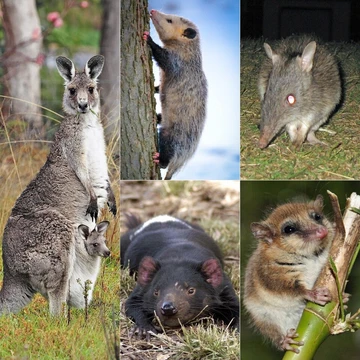
Western grey kangaroo
Large Australian kangaroo with a history of taxonomic confusion.

The western grey kangaroo (Macropus fuliginosus) is a large and very common kangaroo found across almost the entire southern part of Australia. It is one of the largest macropods in Australia and is closely related to the eastern grey kangaroo.
- Scientific name
- Macropus fuliginosus
- Weight
- 28–54 kg (62–120 lb)
- Length
- 0.84–1.1 m (2 ft 9 in – 3 ft 7 in) with a 0.80–1.0 m (2 ft 7 in – 3 ft 3 in) tail
- Height
- Approximately 1.3 m (4 ft 3 in)
- Conservation status
- Least Concern (IUCN)
- Gestation period
- 30–31 days
Lore & Background
The western grey kangaroo was long known to Aboriginal Australians. The current classification scheme emerged in the 1990s.
Reader's Guide
The western grey kangaroo is significant as a widespread and abundant species across southern Australia, playing a key role in its ecosystems as a large herbivore. Its taxonomic history illustrates the challenges early European naturalists faced in distinguishing similar species, with confusion persisting for nearly two centuries. The species is notable for its unidirectional hybridization with the eastern grey kangaroo: viable offspring are produced only when a female eastern grey mates with a male western grey. Ecologically, it exhibits thermoregulatory adaptations, lowering its core body temperature in summer to conserve energy when food is scarce. Its diet during the Late Pleistocene was more varied and included more C4 plants than today. The species is commercially harvested for meat and leather, with about 40% of harvested meat used for human consumption. It is considered a pest in some agricultural areas due to competition for water and pasture, leading to licensed culling. The western grey kangaroo is classified as Least Concern by the IUCN, with an increasing population trend.
Did You Know?
- Mature males have a distinctive curry-like odour, giving the species the nickname 'stinker'.
- It never interbreeds with the eastern grey kangaroo in the wild, but hybrids can be produced in captivity from eastern grey females and western grey males.
- The Kangaroo Island subspecies (Macropus fuliginosus fuliginosus) is endemic to Kangaroo Island, South Australia.
Frequently Asked Questions
How big does a western grey kangaroo get?
Adults typically weigh between 28 and 54 kg (roughly 62 to 120 lb), with a body length of about 0.84 to 1.1 m plus a tail stretching another 0.80 to 1.0 m. At shoulder height they stand around 1.3 m (about 4 ft 3 in), making them one of the tallest kangaroos in the country.
Why was the western grey kangaroo so confusing to classify?
For nearly two centuries, European taxonomists kept mixing it up with its close relative, the eastern grey kangaroo, leading to a long stretch of misidentifications and reclassifications. The confusion only settled once researchers could clearly separate the two species by their distinct ranges and physical traits.
How is the western grey kangaroo related to the eastern grey kangaroo?
The two are very closely related macropods, which is exactly why they caused so much taxonomic headache for so long. The western grey tends to occupy the southern and western parts of Australia, while the eastern grey is more associated with the eastern states.
More in Marsupials 25-32
Elsewhere in the Marsupials universe
Spotted an error? Know more?
This is a living reference — every entry is fact-audited, and reader corrections feed straight into our audit queue. Suggest an edit · See this site's audit record