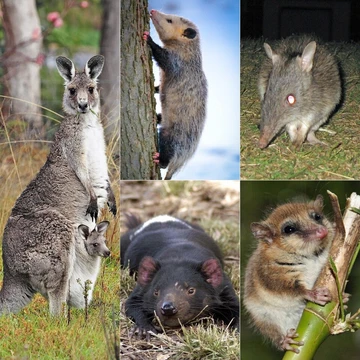
Bandicoot
Nocturnal marsupials endemic to Australia–New Guinea with pig-like snouts.

Bandicoots are a group of more than 20 species of small to medium-sized, largely nocturnal, omnivorous marsupials in the order Peramelemorphia. They are endemic to the Australia–New Guinea region, including the Bismarck Archipelago to the east and Seram and Halmahera to the west. The term 'bandicoot' originally referred to the unrelated Indian bandicoot rat from the Telugu word pandikokku, meaning 'pig-rat'.
- classification
- Order Peramelemorphia
- size
- 11 to 31 in (28 to 79 cm) in length
- weight
- 0.4 to 3.5 lb (0.18 to 1.6 kg)
- diet
- Omnivorous
- habitat
- Endemic to Australia–New Guinea region
- distinctive_feature
- V-shaped faces with prominent noses; fossorial diggers
Lore & Background
Bandicoots have V-shaped faces ending with prominent noses similar to proboscides, making them resemble elephant shrews and extinct leptictids, to which they are distantly related. They are fossorial diggers with well-attuned snouts and sharp claws, and have small but fine teeth for chewing food. Like most marsupials, male bandicoots have bifurcated penises. Their embryos possess a chorioallantoic placenta connecting them to the uterine wall, in addition to the choriovitelline placenta common to all marsupials, though this placenta is small and lacks chorionic villi. Bandicoots can reach 11 to 31 inches in length and weigh 0.4 to 3.5 pounds. They have long pointed snouts, large ears, short bodies, and long tails, with fur that can be brown, black, golden, white, or grey. Their strong hind legs are well adapted for jumping. They also have low body temperatures and low basal metabolic rates, along with low total water evaporative rates and effective panting mechanisms, aiding survival in hot and dry climates. Classification within Peramelemorphia was once thought straightforward, with two families—bandicoots and bilbies—but has become more complex. New Guinean and far-northern Australian rainforest bandicoots were deemed distinct and grouped in Peroryctidae, later reunited in Peramelidae. The pig-footed bandicoot is given its own family, Chaeropodidae. The name 'bandicoot' is an Anglicised version of a Telugu word meaning 'pig-rat', originally applied to unrelated large rats in India.
Reader's Guide
Bandicoots represent a diverse group of marsupials endemic to the Australia–New Guinea region, with over 20 species occupying ecological niches as nocturnal, omnivorous diggers. Their significance lies in their unique reproductive biology—possessing a chorioallantoic placenta alongside the marsupial choriovitelline placenta—and their adaptations to hot, dry climates through low metabolic rates and effective panting. The classification history reflects ongoing taxonomic refinement, with rainforest species once separated into Peroryctidae and later reunited, and the extinct pig-footed bandicoot given its own family. The term 'bandicoot' itself is a linguistic borrowing from Telugu, originally applied to Indian rodents, illustrating how vernacular names can shift across continents. Indigenous peoples of the Australia–New Guinea region have distinct names for bandicoots, such as the Kaurna people's 'bung' or 'marti' for the southern brown bandicoot. Their fossorial behavior, sharp claws, and V-shaped faces with prominent noses make them ecologically important as soil turners and insectivores. The legacy of bandicoots includes their role in marsupial evolution studies and their cultural significance in Australian and New Guinean indigenous traditions.
Did You Know?
- The word 'bandicoot' comes from the Telugu word pandikokku, meaning 'pig-rat', and originally referred to unrelated Indian bandicoot rats.
- Male bandicoots have bifurcated penises, like most marsupials.
- Bandicoot embryos have a chorioallantoic placenta in addition to the choriovitelline placenta common to all marsupials.
- The pig-footed bandicoot is extinct and has its own family, Chaeropodidae.
Frequently Asked Questions
What is a bandicoot?
Bandicoots are a diverse group of over twenty species of small, mostly nocturnal marsupials belonging to the order Peramelemorphia. Despite the shared name, they have no taxonomic connection to the Indian bandicoot rat—the term was borrowed from a Telugu word meaning 'pig-rat' and later applied to these Australian marsupials.
What do bandicoots eat?
Bandicoots are omnivorous foragers that feed on insects, worms, other small invertebrates, and plant material. Their prominent pig-like snouts are especially well suited to sniffing out food buried in soil and leaf litter during their active nighttime hours.
Where do bandicoots live in the wild?
Every bandicoot species is endemic to the Australia–New Guinea region, with their range stretching from the Bismarck Archipelago in the east to islands such as Seram and Halmahera in the west. They are found nowhere else naturally on Earth.
What do bandicoots look like?
They are easily recognized by their distinctive V-shaped faces and prominent, pig-like noses. Many species are also skilled fossorial diggers, using powerful forelimbs to unearth insects and worms from the ground.
How big and heavy are bandicoots?
Depending on the species, bandicoots measure roughly 28 to 79 cm (11 to 31 in) in body length and weigh between 0.18 and 1.6 kg (0.4 to 3.5 lb). This places them in the small-to-medium marsupial range, roughly comparable to a large rat or a small rabbit.
More in Marsupials 1-24
Elsewhere in the Marsupials universe
Spotted an error? Know more?
This is a living reference — every entry is fact-audited, and reader corrections feed straight into our audit queue. Suggest an edit · See this site's audit record